THE PRICE OF SALT (1952)
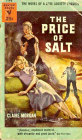 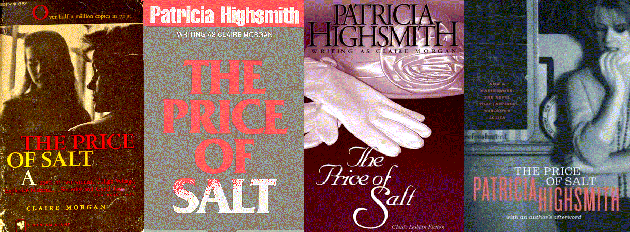
(*Cover images from queertheory.com, "Pre and Post-Stonewall Imagery" at columbia.edu, Naiad publishing, Amazon.com, and W.W. Norton Publishing
In the 1950s, homosexuality either was taboo in literature, or depicted as a temporary laps into vice; characters in lesbian fiction, by the end of a novel, either saw the error of their ways and married a handsome male character, or died tragically— these pulp novels essentially became 10-cent morality plays on sexuality.
However, The Price of Salt, only Highsmith's second novel, made history as the first lesbian novel to have a happy ending.
The Price of Salt tells the story of a young woman named Therese who, working at a department store during the Christmas season, becomes infatuated with a married mother named Carol, who is shopping for a doll for her daughter. The two women form a deep friendship, which soon develops into love.
Unlike many lesbian pulp novels of the period, Highsmith's treatment of lesbian sex was tasteful and focused more on the concept of intimacy than physical acts (Harrison 104). In a scene where Theresa and Carol take a shower together, Highsmith opts for openness and a humorous, human quality to her characters, rather than portraying them as figures whose only connection is sex:
Therese wanted to embrace [Carol], kiss her, but her free arm reached out convulsively and dragged Carol's head against her, under the stream of water, and there was the horrible sound of a foot slipping. "Stop it! We'll fall!" Carol shouted. "For Christ's sake, can't two people take a shower in peace?" (Salt, 211-12).
Highsmith even goes as far as to analyze the nature of gay and lesbian relationships, both morally and whether they are a matter of choice:
[Therese asked] 'Is it anything to be ashamed of?'
'Yes. You know that, don't you?' Carol asked in her even, distinct voice. 'In the eyes of the world, it's an abomination.'
The way she said it, Therese could not quite smile. 'You don't believe that.' (176).
[Carol said] '...the rapport between two men or two women can be absolute and perfect, as it can never be between man and woman, and perhaps some people want just this, as others want that shifting and uncertain thing, that happens between men and women. (229).
Highsmith's novel soon "became an underground classic [and] stood on every lesbian bookshelf during the '50s" (Cassuto 2). This was an amazing step in GLBT literature, but Highsmith herself wasn't credited with this breakthrough. Already labeled as a "suspense" writer, Highsmith published The Price of Salt under the pen name Claire Morgan. While England republished The Price of Salt under the title Carol, and gave Highsmith credit as author, her true role as the creator of the lesbian classic wasn't revealed in America until The Price of Salt was republished in 1991.
{Return to top of page}
FOUND IN THE STREET (1986)

*Cover images from Amazon.co.uk and Barnes&Nobel Inc.
Found in the Street, written thirty-four years after The Price of Salt, was Highsmith's first novel since the 1950s that directly addressed homosexuality.
Normally categorized as one of her more typical "suspense" novels, because a majority of the story deals with a violent murder, Found in the Street also centers on the relationship of a married couple, Jack and Natalia Sutherland.
The marriage between Jack and Natalia is, surprisingly, one of the most healthy marriages that Highsmith has ever written about-- there are no screaming fights, no feelings of resentment, and they even have a healthy daughter named Amelia.
However, Natalia is openly bisexual. In fact, partway through the novel, Natalia becomes sexually involved with the Sutherlands' mutual friend, Elsie. Highsmith makes it clear that both Jack and Natalia are heavily involved in the art culture of New York City, and thus have many gay, lesbian, and bisexual friends.
Jack, rather than being outraged or jealous, instead expresses a tolerant, embracing, and surprisingly approving attitude. Highsmith describes an evening when Natalia is out with Elsie and Jack goes to bed alone. Instead of worrying or feeling hurt, "Jack went to bed feeling happy, and fell asleep at once" (Found, 170).
In fact, when another family friend asks if Elsie and Natalia's relationship "bothers" Jack, he responds,: "No-- not at all" (188).
However, outside of allusions to this relationship, there is "little about the gay characters that [identifies them as] gay other than the narrator's identifying them as such [Overall,] the strong homosexual presence is misleading... [and Highsmith adopts] essentially a conservative view of the issue, certainly running counter to the identity politics of the late 1980s..." (Harrison 109-10).
{Return to top of page}
SMALL g: A SUMMER IDYLL (1995)
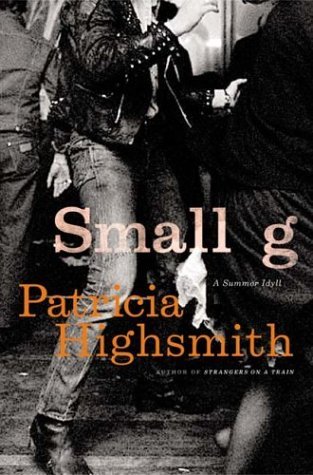
*Cover image provided by W.W. Norton Publishing
Though it was completed in 1994, Small g: A Summer Idyll was not published in America until June 2004. Judged "too shocking" for a mainstream audience, Highsmith's manuscript for Small g was regected by Alfred A. Knopf in 1994. Left without an American publisher, Highsmith released the novel in Europe in 1995, only a few months before her death.
Certainly her most direct and honest treatment of homosexuality and queer relationships, Highsmith addresses such important issues as AIDS, safe sex, and homophobia in the modern world.
The story centers on Rickie Markwalder, a middle-aged gay man whose lover, Petey, was brutally killed six months before. Rickey spends most of his time at a bar, Jakob's, which is noted in tourists' books with a "small g," signaling that its clientele is partially, but not entirely, gay.
What makes this novel such a breakthrough for Highsmith, though, is her direct address of AIDS as a part of the modern sexual culture. Though the character Louis, in Found in the Street, fights a gruesome battle with cancer that many critics feel was supposed to mirror AIDS, Highsmith never directly addressed the subject until Small g (Harrison 110).
When Rickey's friend, Phillip, expresses interest in a sexual relationship, Rickey says:
'In case you haven't heard-- via the grapevine-- I'm HIV positive...'
'What! Oh Rickie... No, I hadn't heard.' Phillip was frowning his sympathy. 'But you know-- well, you can live years-- decades.'
Sure, [Rickey thought,] with a sword over your head, an ax at your throat. (Small, 40)
Another important quality of Highsmith's final novel is that most of the characters in Small g are sexually "queer" in some way or another. Even Rickey's heterosexual friends, Teddie and Luisa, have bisexual or queer tendencies throughout the story. Luisa, in fact, ends up falling in love with Dorrie, a glamorous lesbian who she meets at Jakob's.
By the end of the novel, Luisa is dating both Teddie and Dorrie simultaneously: "'Well, which do you really prefer, Dorrie of me?' Teddie asked a couple of times, and each time Luisa had answered, 'Must I be so precise-- definite?'" (308).
Highsmith's treatement of sexual identity and preference in Small g is amazingly fluid for a writer who came of age during the 1950s. By dealing with this seamless sense of sexual preference, AIDS, and homophobic violence so candidly, one must certainly agree with James Campbell of the Times Literary Supplement when he states: "Patricia Highsmith died having made peace with her demons" (Norton).
{Return to top of page}
THE RIPLEY SERIES

* Cover image from MIRAMAX Films and Amazon.co.uk
Throughout her career, Highsmith's most popular character was Tom Ripley, an elegant and cultured psychopath who appears in five of her novels.
Highsmith writes Ripley with "deliberately equivocal sexual orientation" and very carefully avoids marking the character as gay (Cassuto 2). However, Highsmith also makes it clear that Ripley is by no means heterosexual, either.
In her first Ripley novel, The Talented Mr. Ripley (1955), Highsmith first introduces Ripley as drinking at what appears to be a gay bar in New York. Also, Ripley shares a room with a man in Manhattan who "does department store windows" (Harrison 24). In the 1950s, especially in New York, this would certainly be a clue to the reader that Ripley was homosexual (24).
As the novel evolves, Ripley falls in love with Dickie Greenleaf, the wealthy son of a New York boat builder living in Italy. Highsmith is careful not to directly call this love a sexual love; it is typically described as a love "between brothers" (Talented, 68).
However, the characters of the novel clearly see the fine-line blurring between the two types of love. At one point, Dickie says:
"I'm not queer. I don't know if you have the idea that I am or not."
"Queer?" Tom smiled faintly. "I never thought you were queer."
"...Well, Marge thinks you are."
"Why?" Tom felt the blood go out of his face... Nobody had ever said it outright to him, not in this way.
"It's just the way you act," Dickie said in a growling tone, and went out the door (80).
Though many critics would be quick to label Ripley as being a homosexual character, Highsmith is quick to correct them. "I don't think Ripley is gay," she adamantly stated in a 1988 issue of Sight and Sound magazine (Peary 4).
To support this, in The Talented Mr. Ripley, Highsmith highlights a joke Ripley tells: "'I can't make up my mind if I like men or women, so I'm thinking of giving them both up!'" (Talented, 81).
It is important to Ripley's character that his sexuality is fluid and ambiguous. Critic Anthony Hilfer states: "To anchor Tom's identity in latent homosexuality... is to read against the clear indications in Highsmith's novel that Tom's strength is in his indeterminacy of identity" (qtd. Harrison 25).
In Highsmith's later novels, Ripley's sexuality is mostly either ignored or kept ambiguous. The Boy who Followed Ripley, however, is a notable exception. Written in 1980, most of the novel takes place in the gay community of Berlin. There, Tom and his young companion, Frank, spend time with drag queens and a swarm of gay European men in a club jokingly called the "Glad Ass" (Boy, 120).
Here, Ripley's sexuality is thrown into the spotlight when he reflects:
...almost with a twinge of shame, that perhaps...[they thought] he looked too straight. A miracle they didn't throw him out, and maybe he had Frank to thank for being in. This led to a happier thought: Tom himself was an object of envy for having such a nice looking boy of sixteen in his company. Tom could see that fact now, and it made him smile. (121)
Tom does not appear to feel any sexual lust toward his teenage friend, Frank, but instead is satisfied that he is "in possession" of something beautiful and desirable. In general, in the Ripley novels, Highsmith's protagonist sees sex, and sexuality "as somewhat analogous to one of the finer wines in his cave... something to be appreciated... [but] definitely not a part of everyday life" (Harrison 29).
{Return to top of page} |